Friday, August 16, 2019

Exercise Science Research Gets National Spotlight


Research ranging from NFL Scouting Combine performance to pre-workout supplements to neuromuscular fatigue and muscle swelling were among the topics presented by Bloomsburg University exercise science students this summer at the National Strength and Conditioning Association National Conference in Washington, D.C.

“NSCA was an amazing experience for me,” said Jordynn Kurcoba ‘19, a BU alumna who’s now pursuing a master’s in exercise science. “I never thought I would be interested in research, but my professors pushed me to find something I enjoyed in order to present at the conference. I’m on the path of going into strength and conditioning, so this was an amazing opportunity for me.”

Kurcoba’s research focused on the changes in size and physical performance in the NFL Scouting Combine from 2006-08 to 2016-18. To do that, she researched combine results in body mass, height, bench press repetitions, L-drill, pro-agility drill, vertical jump, broad jump and 40-yd dash time from 1,786 football players. According to Kurcoba, the results were then grouped by positions — offensive line, defensive line, running back, tight ends, linebacker, defensive back and wide receiver.

“Any other positions were excluded,” Kurcoba said. “From there we ran independent samples t-tests to measure any changes in these variables over the 10-year time period. The purpose of this was to assess the changes seen over this time and be able to use this information to tailor an appropriate athletes training.”
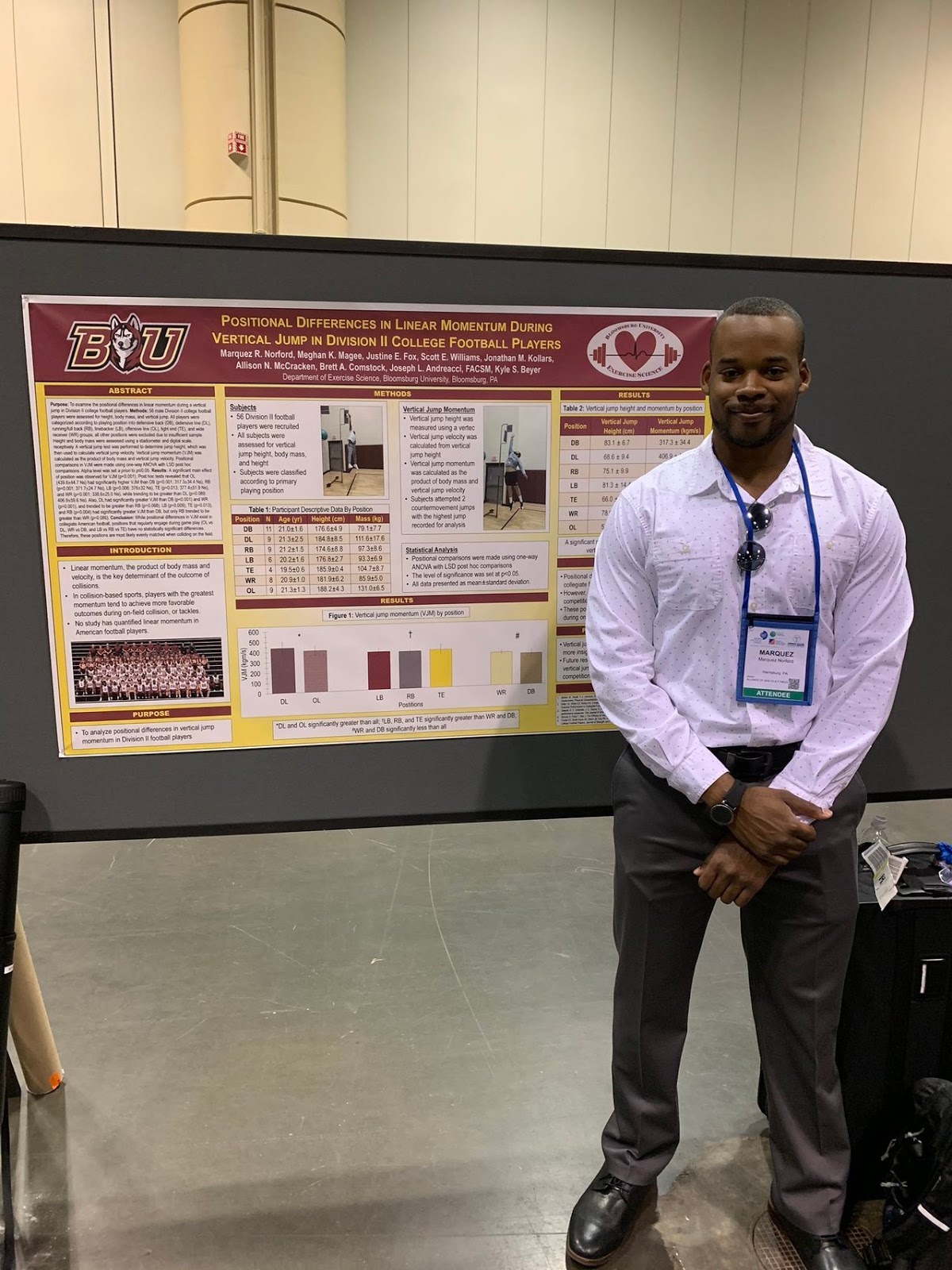
Marquez Norford’s research coincidently involved football as well. However, his had a personal connection and looked at player recovery and conditioning — what happens to an athlete’s body over the course of a season.

“As a former athlete at BU, I know the rigors of being a student athlete and how they can take a tole on one’s body,” said Norford ’17, ‘19M, a former Huskies football player who recently graduated with a master’s degree in exercise science. “We felt the NSCA was the perfect place to present the conclusions we were able to draw. It was a pleasure to be able to present at the national conference and be nominated for the award of ‘Best Masters Research Project.’”


Although not necessarily tied to football, Meghan Magee’s research of a multi-ingredient pre-workout supplement and its effects on repeated sprint ability and exertion did have a BU connection. “A former graduate of the exercise science master’s program works for Cenegenics, which is the company that sent us the supplement, asked us if we’d be willing to conduct a study using it,” said Magee ‘17, ‘19M, noting some key takeaways from NSCA were the importance of networking and presenting research. “You can learn a lot from other people with different perspectives, and some people may be able to provide great opportunities for you.”

The best part about NSCA for Norford was just presenting in front of many different minds in the exercise science field and hearing their feedback. “More than anything, I learned how to be a professional and interact with other professionals while learning about other facets of our field,” Norford said. “Without my master’s degree from BU, I wouldn’t be where I am today. When interviewing for jobs, interviewers were all impressed with the amount of accomplishments I gained throughout my experience at BU.” He added, “I was able to get more hands-on experience out in the real world, as opposed to being in the classroom. I have the exercise science staff to thank for getting me that opportunity. Now, I work for Applied Body Science in Chad’s Ford, Pa., and it’s honestly a dream come true. I know that I have a future here.”

According to Kurcoba, the NSCA experience was also a great networking opportunity for her too.
“That was they key part of this conference for me,” Kurcoba said. “I met so many amazing people in the field of strength and conditioning and have already been contacting some of them to keep in touch after! I love how well rounded this (BU) program has made me, showing me that just because I want to work in the field and not in a lab doesn’t mean that there isn’t research opportunities for me that I actually enjoy.”

For Magee, NSCA officially concluded her BU chapter and now readies for her pursuit of a Ph.d. beginning this fall at George Mason University.
“As a graduate of both the undergraduate and graduate program, I can definitely say all the faculty want the students to succeed in any path they choose to take after graduation,” Magee said. “Bloomsburg’s exercise science program has prepared me for my next step in my academic career.”

Research Presentations
  • Monitoring of Body Composition and Physical Performance in a Division II Football Team Throughout a Competitive Season, presented by Marquez Norford
  • Effects of a Multi-Ingredient Pre-Workout Supplement on Repeated Spring Ability and Perceived Exertion, presented by Meghan Magee
  • Changes in Size and Physical Performance in the NFL Scouting Combine, presented by Jordynn Kurcoba
  • Gender Comparisons of Rate of Neuromuscular Fatigue Across Handle Types During Seated Row Exercise, presented by Tatum Mack
  • Relative Fatigue but Not Muscle Swelling is Affected by Maturity Status in Youth Male Athletes, presented by Shawn Reese
  • Relative Age Effects in Elite Olympic Weightlifting, presented by Jonathan Kollars
The National Strength and Conditioning Association (NSCA) is a nonprofit professional organization dedicated to advancing the strength and conditioning profession around the world. NSCA advances the profession by supporting strength and conditioning professionals devoted to helping others discover and maximize their strengths. We disseminate research-based knowledge and its practical application by offering industry-leading certifications, research journals, career development services, and continuing education opportunities.  NSCA is composed of more than 45,000 members and certified professionals who further industry standards as researchers, educators, strength coaches, personal trainers, and other roles in related fields.
`~from https://bloomsburgu.tumblr.com

Tuesday, August 13, 2019

BloomBus Shuttle-Tracker shown at SVURS

Nicholas Ashenfelter and Michael O’Donnell with their poster
Computer Science majors Nicholas Ashenfelter and Michael O’Donnell presented a poster at the 2019 Susquehanna Valley Undergraduate Research Symposium (SVURS), describing their work on the BloomBus project to track campus shuttles. The symposium, held at Bucknell University, showcases work done by students at Bloomsburg, Bucknell, Susquehanna University, and Geisinger Medical Center.

The BloomBus project aims to install GPS trackers in the campus shuttle buses to monitor their locations, and use a smartphone-based app to predict a bus’ arrival time at its next bus stop. This will assist shuttle users who wish to avoid excessive waits out-of-doors in bad weather. Commercial systems exits to provide this function, but at a substantially greater cost than the BloomBus project’s equipment and maintenance. Started by Rio Weber and David Pany, it has been under development by successive groups of studentsfor the last few years. 2019 alumnus John Gibson continues to assist Nicholas and Michael on the software development.

The project has reached a testing stage at which GPS units are ready to be deployed in shuttles, and tracking data collected to build models for predicting arrival times at the various bus stops.

Monday, August 12, 2019

Students Present at Susquehanna Valley Research Symposium


The 9th annual Susquehanna Valley Undergraduate Research Symposium was held on July 31, 2019 at Bucknell University. This event was sponsored jointly by Bloomsburg University, the Bucknell Center for Social Science Research, Geisinger, and Susquehanna University.  It is a valuable opportunity for students in central Pennsylvania to showcase their research activities, learn about other methods and disciplines and gain the experience of presenting at a professional conference.  This year more than 100 students presented posters.

The following COST students presented their research at the symposium.

Nicholas Ashenfelter — “BloomBus Project”
Guy Bennardo — “Role of Dopamine D1-Like Receptors in Chronic Stress-Potentiated Relapse to Palatable Food Seeking Following Punishment-Induced Abstinence”
Stephan Budkin — “Template-Free Nanofabrication of High Surface Area Electrodes”
Michael Engle — “Using OSINT Techniques for Human Trafficking”
Michael Facella — “The Extent of Microplastics in Chesapeake Bay Shrimp”
Tara Full — “Effects of BORIS on TERRA Transcription”
Robert Grow — “The Comparison of Barbell Velocity between Linear Position Transducer and iPhone Application during Squat”
Kyle Mausteller — “Investigating the Role of CTCF on Telomere Replication”
Michael O’Donnell — “BloomBus Project”
Jessica Paoletti — “Parental Foraging Effort of Tree Swallows (Tachycineta Bicolor) in Different Chick Age Classes”
Austin Pasquel — “How Virtual is a Virtual Machine?”
Sweetie Patel — “The Wall: Perceptions of Flood Protection and Residential Responses in Bloomsburg, Pennsylvania”
Michael Rumbough — “Drone Efficiency, Investment, and Consequences of Use”
Adam Shultz — “Role of Dopamine D1-Like Receptors in Chronic Stress-Potentiated Relapse to Palatable Food Seeking Following Punishment-Induced Abstinence”
Sierra Smith — “The Extent of Microplastics in Chesapeake Bay Shrimp”
Kayla Sompel — “Associating melanoma tumor cell plasticity with resistance to clinically relevant MAPK inhibitors”
Leah Topping — “Use of UAV Technology in Reconstructing the Alluvial Architecture of Triassic-Jurassic Stratigraphy, Colorado Plateau, Arizona and Utah”
Lakota Wadena -- "Autumn Gut Contents of Allegheny Crayfish and Rusty Crayfish Introduced in Eastern Pennsylvania"
Jordan Wyant — “Riding the digital highway with outlaw motorcycle gangs: Applying OSINT techniques to assess member criminality and connectivity”
Stephan Budkin — “Template-Free Nanofabrication of High Surface Area Electrodes”

Michael Engle — “Using OSINT Techniques for Human Trafficking”

Michael Facella — “The Extent of Microplastics in Chesapeake Bay Shrimp”

Austin Pasquel — “How Virtual is a Virtual Machine?”

Nicholas Ashenfelter and Michael O’Donnell — “BloomBus Project”

Kayla Sompel — “Associating melanoma tumor cell plasticity with resistance to clinically relevant MAPK inhibitors”

Thursday, August 8, 2019

Bloomsburg University Audiology Students Receive White Coats


Bloomsburg University of Pennsylvania held its annual Audiology White Coat Ceremony on Saturday, Aug. 3, at the Caldwell Consistory in Bloomsburg for its Doctor of Audiology Class of 2021.

 The white coat ceremony marks the completion of the students' pre-clinical coursework and symbolizes their sentry into clinical practice.

Receiving white coats were:  (Top left to right) Taylor Budwash, Briann Halpin, Cece Campanile. (Middle left to right) Georgie Wagman, Gabrielle Poplarchick, Taylor Parker, Taylor Chestnut, Kaitlin Mausteller, Abigail Schell. (Bottom left to right) Kylie Connell, Danielle Avenoso, Alina Garrido, Jessica Depol, Kayla Murphy.

~ from https://bloomu.meritpages.com

Monday, August 5, 2019

Students complete internships at Blue Marsh National Recreation Area and Refreshing Mountain's Wildlife Center


Amanda Aulenbach conducts internship at Blue Marsh National Recreation Area 
Amanda Aulenbach and  Bobber
the water safety dog at
Blue Marsh Lake.

Amanda Aulenbach, a BS Biology major and Geography minor, conducted an internship at Blue Marsh Lake in Leesport, PA. Originally built by the Army Core of Engineers for flood control, Blue Marsh Lake is also a popular recreation area that is open 365 days a year and attracts 900,000 visitors annually. The lake has 1,150 surface acres of water for swimming, boating, and fishing and 6,200 acres of land containing hiking and horseback riding trails, picnic areas, and boat ramps. Operated by the US Army Corps of Engineers Philadelphia District, the mission of Blue Marsh Lake is to promote water safety, to provide opportunities for outdoor recreation, and to conduct outreach activities related to the outdoors.

 During her internship, Amanda's duties included trail maintenance, patrolling the grounds, beaches, and dams, assisting visitors, and checking water quality. To prepare for these duties, Amanda received training in first aid, CPR/AED, brush fire control, self-defense, defensive driving, pepper spray use, contacting emergency medical services, issuing warning citations, and boat safety. Her water safety training included the proper use of kayaks and water rescue. Amanda also participated in owl hikes and bat counts with the visitors.


Amanda's favorite part of her internship
experience was how every week was different. There was always something new happening. In addition to learning new skills, she enjoyed working with the other interns and making connections with the rangers. Her absolute favorite experience was helping to rescue a heron that was tangled in fishing line. After cutting the heron free, she wrapped it in a blanket and held it securely until the Red Creek Wildlife workers arrived to treat it for any cuts and bruises. This experience has led Amanda to consider a career helping animals, perhaps at a sanctuary. Dr. Thomas Klinger was Amanda's academic supervisor.


Alyssa Williams explores herpetology at internship site

Alyssa Williams and the hog nose snake


Alyssa Williams, a BS Biology major, Ecology, Conservation, and Field Biology option, and Spatial Analysis and GIS minor, is conducting an internship at Refreshing Mountain’s Wildlife Center in Stevens, Pa. She cares for reptiles and amphibians at the facility and teaches school groups about herpetology.  As part of her internship, she practiced snake identification in the Pocono Mountains. She and her coworkers identified a total of 23 snakes including a copperhead and timber rattlesnake. In the photo at right, Alyssa holds a hog nose snake (who is playing dead!)  Dr. Steven Rier is Alyssa's program adviser

~from http://bloomsburgbiosynthesis.blogspot.com/ 

Sunday, July 28, 2019

Student conducts research in Honduras and aids in coral reef restoration


Caitlyn Collins, a master's student mentored by Dr. Thomas Klinger, conducted research this summer on sea urchins at the Roatan Marine Park in Honduras. Caitlyn's thesis work investigates the thermal tolerance of sea urchins in order to understand the potential impacts of climate change.

She examined sea urchin abundance using the roving diver method, which is swimming at specific depths , typically 10, 15, and 20 meters for a specific time. Caitlyn determined the depth, temperature,and abundance of sea urchins, along with the coexisting species. Her preliminary data showed that the most abundant sea urchin was Echinometra viridis (Reef Urchin), typically found living in the crevices of Agaricia tenuifolian (Thin Leaf Lettuce Coral).

 In addition to her own research, Cailtyn assisted with a coral restoration project that is underway at the Roatan Marine Institute. The project involves connecting fragments of Acropora cervicornis (Staghorn Coral) and Acropora palmata (Elkhorn Coral) to a tree. This allows the coral to grow without the threat of predation and disturbance. Once the coral fragments reach a certain size, they are replanted onto the reef. This conservation effort is aimed at restoring coral reefs. Both of these coral species are very important to the foundation of coral reefs and are critically endangered species.
~from http://bloomsburgbiosynthesis.blogspot.com/


Monday, July 1, 2019

Pre-med major interns in Kenya thanks to PEG award


Allison Sowers developed a deeper understanding of herself and the world she lives in during a recent internship with International Medical Aid (IMA) in Mombasa, Kenya. Sowers, a biology and pre-medical sciences major, spent three weeks in Kenya working with IMA at the Coast Provincial General Hospital. International Medical Aid, founded by two Johns Hopkins alumni, is a not-for-profit organization based in the United States. IMA strives to improve the health of underserved individuals in South America, East Africa and the Caribbean through mobile medical clinics, public health education programs and first responder training.

Sowers fascination with the medical field came from having been in and out of hospitals many times in her young life, including a surgery on the day she was born for blockage of a small upper intestine. “My biggest takeaway from going there might sound cliché, but the IMA internship taught me that heart is more important than privilege, resources, or money,” said Sowers. “My time in Mombasa allowed me to experience Kenya’s healthcare system firsthand and opened my eyes to how underprivileged the public hospitals are in that country. According to IMA, the Kenyan government spends only 24 USD on health care per capita, and only 4.6 percent of the gross domestic product goes towards health expenditures.”

Sowers, who plans on going into pediatric anesthesiology, was able to take the internship after being awarded a Professional Experience Grant (PEG) from Bloomsburg University. The money covered the cost of her trip to the African nation and experience many different areas of the healthcare field while there. “I shadowed doctors in departments of my choosing (pediatrics, emergency, and surgery),” said Sowers. “Outside of the hospital, I also participated in community outreach activities like hygiene clinics at a local school, a menstruation clinic for young girls, and a community medical clinic for school children and their families at Milele Elimu Center. I also got to participate in a suture and IV clinic. In my free time, I got to explore Mombasa and surrounding areas and learn about the culture of Kenya.” Sowers was nervous in advance of the trip, but quickly adapted to her surroundings. “Yes, I was nervous for flying by myself, but once I got to Mombasa and was picked up by my program mentors, I felt right at home,” Sowers added. “There were interns from all over the world and we quickly bonded. I am still communicating with them regularly.”

One of the biggest lessons learned during her internship was how to be resourceful to solve problems. “While working in the newborn unit, my mentor explained to me that they don’t have enough incubators when the babies are born, so they do a “kangaroo” technique by wrapping the babies against their mother’s chest to keep them warm,” said Sowers. “These are problems that I will probably never have to experience in the U.S., but the doctors at CPGH don’t complain; they just take the necessary steps to get the job done.” Her most essential takeaways from the trip will be life-changing for her, though. “The heart and compassion shown by the Kenyan doctors I was able to interact with is something that I most definitely will carry with me into my profession,” said Sowers.

“I hope to learn to bite my tongue and not complain at every little inconvenience in my life and to find another solution. I hope to be able to educate others in the American health care system and inspire them to go into the field for the right reasons. Most importantly, I plan to go back to Kenya and other underprivileged areas to share aid and resources with the people and doctors in these countries. I look forward to being able to do this when I am a medical professional myself so that I can provide more assistance and feedback.”

~https://bloomsburgu.tumblr.com/