Showing posts with label Digital Forensics. Show all posts

Friday, May 15, 2020

Bloomsburg University Students Take Top Two Spots at Cybersecurity Event

The Pennsylvania National Guard hosted a virtual Wi-Fighter Challenge April 24 as part of DeSales University's Third Annual Cyber Security and Digital Forensics Conference. To maintain the physical interaction involved in previous exercises, the organizers mailed the first 50 participants to sign up a Raspberry Pi Kit, a mini computer popular with hardware hacking, which was the focus of the exercise. (U.S. Army National Guard courtesy photo) (Photo by Staff Sgt. Zane Craig)
Bloomsburg University of Pennsylvania digital forensics majors Nelson Maher and Austin Pasquel finished one-two at the Pennsylvania National Guard Wi-Fighter Challenge on Friday, April 24. The event was part of the third annual Cyber Security and Digital Forensics Conference hosted by the Pennsylvania National Guard.

Held virtually this year due to the COVID-19 pandemic, the three-hour Wi-Fighter Challenge gamifies concepts to teach the foundational skills required by cybersecurity experts.
To maintain the physical interaction involved in previous exercises, the organizers mailed the first 50 participants to register a Raspberry Pi Kit, a mini-computer popular with hardware hacking, which was the focus of the exercise.

Maher and Pasquel, both of Nazareth, competed against more than 70 other contestants from 11 states. The expanded reach was the greatest benefit of the virtual event, according to organizer Capt. Sean Smith, deputy cyber team chief for the Pennsylvania National Guard.

“The key to success with the virtual event versus the live events were to communicate early and often to get individuals prepared and committed to attend,” said Smith. “We leveraged popular digital collaboration tools as a communication force multiplier.”

First-place finisher Maher entered the event to put what he learned at BU into action. “I learned how to better apply the skills taught in the digital forensics program,” said Maher. “A Raspberry PI is a small, USB powered single board computer. Due to its size, cost, and ease of use, it’s widely used in educational and enthusiast projects. “

“As someone who has done a few cyber competitions, I was very pleased with how this one turned out,” said Pasquel. “I learned how to set up and use a Raspberry Pi, a skill I have always wanted to learn. The challenges started with background info on the Pi, to how to set it up, basic Linux commands, intermediate Linux knowledge, up to the final challenge of a reverse engineering problem.”

For Maher, this area of study has always been an interest. “It’s the reason I chose BU. The maturity, age, and depth of the digital forensics program at BU completely blew the offerings from other institutions out of the water.”

After graduation this May, Maher moves right into a position. “I will start work as a junior penetration tester, but I want to continue to learn and teach others about the field.”

Pasquel, who graduates in Spring 2021, also selected BU for its digital forensics program.
“This is one of the best cybersecurity/digital forensics programs out there as the program was built from the ground up with that specific focus,” said Pasquel. “All my faculty have been great. Dr. (John) Riley has been very influential and is my adviser on my research project that has been going on for more than a year.”

Pasquel is already looking to life after graduation. “I am considering graduate and doctoral programs, Department of Defense positions (from the possibility of a DOD Cyber Scholarship), and the private sector.”

~https://archive.bloomu.edu/news-releases/20-05-06

Monday, December 16, 2019

Digital forensics major takes on bug bounty hunting


As a 10-year-old playing video games Jeremy Dilliplane had his first experience with the darkness of cyberspace. Battling against online cheating and game-based cyberattacks fostered a passion for cybersecurity.

That passion and now hobby — further sparked by a digital forensics class on small devices last year — led the Bloomsburg University digital forensics major to uncover a data exposure by a well-known networking company. “My discovery was quite shocking,” Dilliplane said. “Not only did I find sensitive information, but my own data was also at risk.”

According to Dilliplane, the foundation of his digital forensics skills on small devices started with Diane Barrett, professor of mathematical and digital sciences and director of BU’s cyber defense education. “I learned how to interface with small devices to see data and acquire a forensic snapshot of the phone,” Dilliplane said. “I also learned key places to look for evidence in Apple iOS and Android OS file systems that hold different kinds of valuable information, such as address books, call logs, web browsing history, application configurations, and several other locations that a typical user wouldn’t see unless they are using forensic tools.”

A special interest immediately developed and Dilliplane started exploring on his own smartphone in his makeshift digital forensics lab at home. “I was able to pull data from my phone, which led me to uncover a networking company’s sensitive information that was exposed to all users who had downloaded this application,” Dilliplane said. “While I was going through the acquired data for all of the applications I installed on my smartphone, and with my hobby being information security, my alarm went off when I recognized private API keys and a private server authentication key.”
Dilliplane said API keys are generally not considered secure, however, are mainly distributed to only customers and clients for usage. In this instance, he said the networking company was a client to multiple other companies that provided different types of services from storing application usage statistics to containing other private information.

“The exposed keys were a vulnerability and could have been abused to pull and read private data belonging to customers and employees,” Dilliplane said. “As soon as I encountered the vulnerability, I wrote a full, thorough report on my findings and contacted the networking company’s security team right away.” According to Dilliplane, he was a tad late. In a good way. “I was thanked by the team for reporting the issue,” Dilliplane said. “However, no bug bounty was rewarded for the find, because they were already processing a report from another bug bounty hunter.”

A bug bounty is a deal offered by websites and software developers for reporting bugs and vulnerabilities. According to Dilliplane, bug bounty hunting can be very competitive.
“A common courtesy when finding such vulnerabilities — especially those that could lead to massive data leaks — is to keep it private until the company can securely patch the vulnerability and no one can exploit it for personal gain,” Dilliplane said. “Bug bounty hunters and hackers know that where there’s one vulnerability, there are often more. In this case, the company asked to not be disclosed.”
Dilliplane’s ability to uncover the data exposure and to “compete” in the bug bounty world can be directly attributed to groundwork laid by BU’s digital forensics program.

“The digital forensics program (here) provides students with not only the investigative and recovery skill sets, but also the knowledge and skills in almost every area I can think of when it comes to cybersecurity,” Dilliplane said. “All of the material is covered in depth, and most importantly, the faculty care about you and your future. It’s also recommended and encouraged that all students in the major join available clubs, such as the Digital Forensics and Cyber Defense Club, where you can learn even more.”

Dilliplane, who for the past two years has assisted NETGEAR Inc. privately test its products for bugs prior to market release, has his sights set on a cybersecurity career somewhere in the government sector. “We can see in the news that hackers (both foreign and domestic) often attempt and are sometimes successful at hacking into our critical information systems to steal or exploit them,” Dilliplane said. “These critical information systems can contain intellectual property, control our infrastructure (like power grids), or even allow us to vote. I believe (BU’s) digital forensics program has prepared me to apply my skills to identify these malicious actors and hopefully defend against them.”

~from bloomsburgu.tumblr.com

Wednesday, November 13, 2019

Digital Forensics Students attend Grr Con

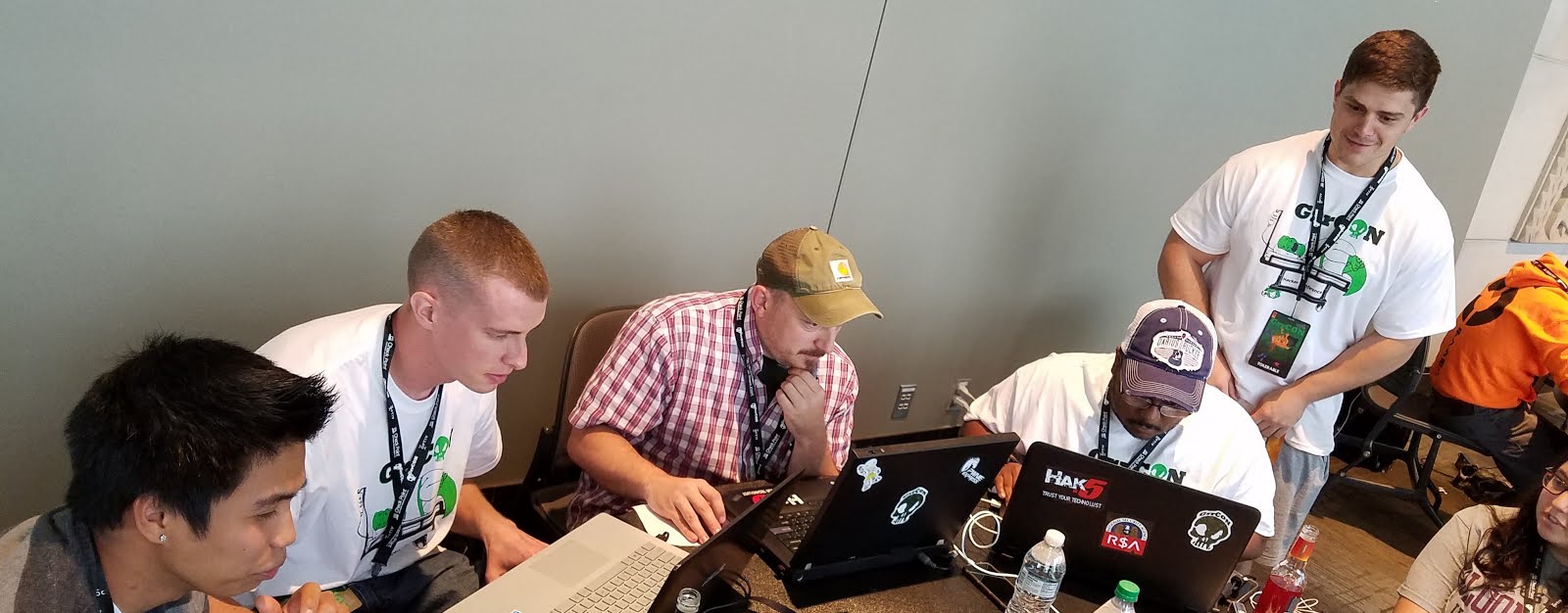
Thirty-two digital forensics and computer science students, accompanied by MADS professor Phil Polstra, recently attended GrrCon in Grand Rapids, MI.

GrrCON is an information security and hacking conference that provides the Midwest InfoSec community with a fun atmosphere to come together and engage with like-minded people.

Events included programming contests, professional hands-on workshops, networking among professionals, and keynote presentations. Students gained professional experience in computer programming and digital forensics through hands-on programming contests and interactions with professionals in the cybersecurity field.

This Husky Career Road Trip was partially funded by Alumni and Professional Engagement.  All students attended a pre-conference workshop, conducted by Stephen J. Jones Professional U Fellow Abby Hare-Harris. At this workshop, students designed and practiced their “two-minute pitch” or “elevator pitch” in preparation for both formal and informal networking opportunities throughout the conference. At the conference, students were also able to explore jobs and internship opportunities through the GrrCON talent accelerator program.


Friday, September 27, 2019

Digital forensics majors identified as new cyber talent


Four Bloomsburg University digital forensics majors now have their eyes set on working for the Department of Defense as a result of earning a DoD Cyber Scholarship for this school year. Each cyber scholar receives full tuition, fees, a book allowance, and a stipend for living expense in exchange for civilian service at a DoD Agency upon graduation.

“We’re very proud of our digital forensics curriculum and the students we educate,” said Curt Jones, chairman of the mathematical and digital sciences department. “These scholarships are the result of these students’ ability and education provided by our professors. They’re only possible because of our designation as a National Center of Academic Excellence in Cyber Defense Education that Dr. Barrett obtained for us. Her excellent work in this area has now led to six students receiving these highly coveted scholarships.”

DoD’s Cybersecurity Scholarship Program is designed to increase the number of qualified students entering the fields of information assurance, information technology, and cybersecurity to meet the DoD’s increasing dependence on cybersecurity for war fighting and the security of its information infrastructure. “The scholarship award an excellent testament to the caliber of our digital forensic students,” said Diane Barrett, associate professor of mathematical and digital sciences. “It also demonstrates the high quality of the digital forensics curriculum and faculty expertise. This is an exceptional opportunity for our students to make a difference in the effort to secure the digital assets of our country.” Due to the sensitivity of the jobs within DoD, student names are being withheld.

BU is designated as a National Center of Academic Excellence (CAE) in Cyber Defense Education with a focus in the area of digital forensics. The CAE designation, jointly sponsored by the National Security Agency and the Department of Homeland Security, recognizes that Bloomsburg’s digital forensics program has met stringent criteria in regard to its digital forensics curriculum, faculty and research, as well as demonstrated an institution-wide commitment to information assurance practices and cyber defense education. Students attending CAE designated schools become eligible to apply for related scholarships and grants through the Federal Cyber Service Scholarship for Service Program.
~from https://bloomsburgu.tumblr.com

Wednesday, April 24, 2019

Digital Forensics Certificate Program Featured


Bloomsburg Universities Digital Forensics certificate program is currently featured on the National Initiative for Cybersecurity Careers and Studies (NICCS) webpage.

The text from the page states,
"Bloomsburg University offers the only digital forensics certificate program in the Pennsylvania State System of Higher Education and one of the only bachelor level digital forensics certificate programs in the country. Completing the program will qualify the certificate recipients to apply for abundant employment opportunities in the cybersecurity and digital forensics fields.

The digital forensics certificate program is fully online allowing you to attend classes from anywhere in the world and complete the following course work based on your schedule. The curriculum is divided into six courses and can be completed in about one year.

The curriculum covers in-depth topics and provides hands-on exercises.

Digital forensics certificate students will:
Analyze file systems found on hard drives and other digital media
Recover deleted pictures, documents, and internet activity
Trace network activity to find weaknesses and compromises
Determine system and network vulnerabilities
Discover ways to protect systems and data from hackers
Utilize industry standard forensic software to analyze digital media images

The main focus of the digital forensics certificate is supporting the national mission to educate and train the Nation’s future cybersecurity workforce. The digital forensics certificate program offers the rigorous training necessary to immediately join the workforce. Bloomsburg University has excellent and well-known faculty members with practical experience and deep knowledge in this field of study. For those interested in a degree program, in addition to the online certificate program, Bloomsburg University offers a Bachelor of Science degree in Digital Forensics."

Monday, April 15, 2019

2019 Science Iditarod

Overall 1st place team, Chemistry round, and Physics round winners: The Ball Bearings from Shamokin
The 2019 Science Iditarod was held last week on the Bloomsburg University campus. Local high schools sent teams of four students to compete in the quiz competition. Four separate quiz rounds consisted of questions from the Geosciences, Biology, Physics and Chemistry. This year saw a smaller crowd than in years past, with 10 teams from 6 different schools. Winners were recognized in each category with a plaque. The“Gold” team from Wyoming Area won both the Geosciences and Biology rounds. “The Ball Bearings” team from Shamokin won both the Chemistry and Physics rounds.

The points earned in each round were tallied and the top two teams advanced to the Super Round where the overall winner would be crowned. The overall 3rd place winner was team “A” from Wallenpaupack, the overall 2nd place winner was the “Gold” team from Wyoming Area and the first place team was “The Ball Bearings” from Shamokin. Each of the top 3 teams won a trophy, and individual medals. The team members of first place team also each received a $1000 scholarship to attend Bloomsburg University. Bloomsburg University is proud to sponsor this event to encourage high school students in the sciences and plans to offer the contest again next year.

Overall second place, Geosciences round, and Biology round winners: The Gold team from Wyoming Area

Overall Third Place winners: Team "A" from Wallenpaupack

Monday, April 1, 2019

BloomCON 2019

Over 500 people participated in BloomCON this past weekend at Bloomsburg University.  BloomCON is Bloomsburg University’s annual digital forensics, cybersecurity, and hacking conference. The conference hosts a variety of speakers and features unique workshops and cybersecurity challenges. This year there were speakers and workshops at all levels, including lock picking, hardware hacking, drone hacking, numerous competitions and villages, plus Dual Core performing at the networking party.   The competitions included the second annual Drone Wars in partnership with the US Army, wireless hacking, open source intelligence, capture the flag, forensics, and more.

The keynote speaker was Mike Daugherty, who gave a talk entitled "Cybercriminals, Politicians and Bureaucrats: What Could Possibly Go Wrong?"  Mike Daugherty is the CEO of LabMD, a cancer testing laboratory and Founder of The Cyber Education Foundation.

BloomCON was also held in conjunction with Hak4Kidz, co-sponsored by the Bloomsburg Children's Museum , which involved around 250 kids this year.


Drone Wars Results High School Division
First Place: à WIFI Pirates from West Side Career and Technology Center
Team Members: Adam Frederick , Matt Jones, Gage Wilison
Advisor Dr. Gary Miller

Drone Wars High School Division Winners
Second Place: à Game of Drones from West Side Career and Technology Center
Team Members : RJ Salvo, Derek Keeler, Rich Zimmerman
Advisor Dr. Gary Miller Open Division

Open Division
First Place: à ROCK from Slippery Rock University
Team Members: Dante Cicco, Dante Zitello, Jacob McMahon
Advisor: Dr. Nitin Sukhija

Drone Wars Open Division Winners (3 in the center)
Second Place: à CHADHACK from Slippery Rock University
Team Members: Chad Dewing, Adam Davenport, Kunj Champaneri
Advisor: Dr. Nitin Sukhija

Third Place: à Bubble’s Bros from Bloomsburg University
Team Members: Adrian Perez, Nicholas Senske, Austin Pasquel, Bryan Iadisernia
Advisor: Dr. Diane Barrett

Congratulations to Dr. Phil Polstra and the Digital Forensics Club for providing an outstanding conference this past weekend.


Tuesday, March 5, 2019

Inch to Give Talk on Open Source Intelligence and Doxing

Scott Inch, professor of mathematics and digital sciences, will speak about "OSINT and Doxing and Dorks, Oh My!" on Wednesday, March 20, at 6:30 p.m. in room 108, Hartline Science Center, Kuster Auditorium. Inch’s talk, part of the College of Science and Technology Dean’s Lecture Series, is free and open to the public.

Open Source Intelligence (OSINT) techniques are used by the government, hackers, and internet trolls to find publicly available information, typically on the internet. OSINT can be used for good, like searching for a video on how to fix a computer. But it can also be used for evil, like searching for the personal information of someone and releasing it online (doxing). This talk is a general introduction to the type of information that can be found online and the methods for finding it. Learning more about these techniques will also allow attendees to secure their own personal data more effectively.

Scott Inch, Ph.D., CCE, is an educator, digital forensics practitioner and subject matter expert. He has taught hundreds of students, law enforcement personnel, federal agents, corporate employees and private detectives to perform digital forensics analysis. He is a lifelong educator who was recently chosen from over 200 applicants as Pennsylvania Technology Educator of the Year by TechQuest. Dr. Inch has a broad range of expertise in many areas of digital forensics, including file systems, traditional hard disk forensics, mobile devices, and Ediscovery. He actively does both civil and criminal case work, submits expert reports, and has been declared an expert witness several times for court testimony in depositions, preliminary injunctions, and arbitration hearings. Dr. Inch has worked with a variety of forensics software vendors in various capacities. He was an instructor and developed curriculum for Paraben Corporation in the Level 3 course on GPS, call detail records and the cellular network. He has also worked with AccessData and Syntricate as an instructor for mobile forensics. In addition, he has had input into the improvement and development of forensics tools from a variety of vendors.

Thursday, December 6, 2018

Recent Publications and Grants

Recent Publications
Erik Larsen, assistant professor in Chemistry, recently published a paper, “Microbial esterases and ester prodrugs: An unlikely marriage for combating antibiotic resistance” in Drug Development Research. This work was a collaboration with a chemist at Butler University.


John Pohill, professor of mathematical and digital sciences, recently published a paper, “Relative and almost linking systems”, in Journal of Algebraic Combinatorics. This work was a collaboration with mathematicians from University of Richmond and Sam Huston State University.


Robert Aronstam, Dean of the College of Science and Technology, recently published a paper, “Intracellular Delivery of Nanoparticles Mediated by LactoferricinCell-Penetrating Peptides in an Endocytic Pathway“ in Journal of Nanoscience and Nanotechnology. This work was a collaboration with scientists from National Dong Hwa University, Taiwan and Missouri University of Science and Technology.


Shaheen Awan, professor of Communication Sciences and Disorders, recently published a paper, “A Two-Stage Cepstral Analysis Procedure for the Classification of Rough Voices” in Journal of Voice. This work was a collaboration with a statistician at Penn State University.


Ben Franek, Assistant Professor in EGGS, recently published a paper, “Glyptemys insculpta (Wood Turtle). Rail trail nesting challenges” in Herpetological Review with recent BU graduate Morgan Ruziecki.


Barry Minemyer, assistant professor of MADS, recently published a paper, "Real hyperbolic hyperplane complements in the complex hyperbolic plane" in the journal Advances in Mathematics (AIM).


Matthew Polinksi, assistant professor of Chemistry, recently published a paper, “Synthesis, Characterization, and Structural Comparisons of the First Neodymium(III) Sulfite-Acetate Crystal Structure” in Zeitschrift für anorganische und allgemeine Chemie (Journal of Inorganic and General Chemistry). This work was in collaboration with scientists from Creighton University.


The following Research and Scholarship Grants were awarded to COST faculty from the Bloomsburg University Office of Research and Sponsored Programs for January 1, 2019 through February 28, 2020.


Clay Corbin, BAHS: “Mosquito Surveillance and Documentation of Bycatch in Ruffed Grouse Habitats”, $3500


George Davis, BAHS: “Analysis of the AvsYS1 Gene Functionality Using Yeast, Arabidopsis, and Tomato”, $3300


William Schwindinger, BAHS: “Targeted Disruption of a G-protein Gamma-Subunit Gene in Chinese Hamster Ovary Cells”, $3500


Angela Hess, BAHS: “Associating melanoma tumor cell plasticity with resistance to clinically relevant MAPK inhibitors”, $3500


Daniel McCurry, Chemistry and Biochemistry: “Template-Free Nanofabrication Of High Surface Area Electrodes”, $3500


Erik Larsen, Chemistry and Biochemistry: “Synthesis and Design of Novel Enzyme Probes for Mycobacterial Hydrolases”, $3500


Joseph Andreacci, Kyle Beyer, and Luke Haile, Exercise Science: “Influence of Testing Sequence on the Ability to Achieve Anaerobic Power and Aerobic Power in Adults” $3,041


Scott Inch, MADS and Scott Duncan, Criminal Justice: “Protecting Peaceful Protests: Exploring a Digital Early Warning Violence Prevention Strategy”, $3,357

Thursday, April 20, 2017

Dr. Diane Barrett earns the Provost’s Award for Excellence in Research/Scholarly Activity

Dr. Jones, MADS Chair; Dr. Barrett; Dr. Blake, provost; Dr. Aronstam, COST Dean
Dr. Diane Barrett was recognized by Provost Blake for outstanding scholarly activity at an awards dinner on April 17. The Provost’s Award for Excellence was established in 2006 to recognize and encourage continuing scholarly achievements of probationary faculty. One award winner is named for each of the four colleges at Bloomsburg University. Dr. Barrett is an expert digital forensics professional who brings a unique depth and breadth of knowledge into the classroom from her vast professional experiences. Her hiring allowed Bloomsburg University to greatly strengthen an already impressive program into a national leader in Digital Forensics education. Diane single-handedly created the department’s Center of Excellence application to the National Security Agency (NSA) in the summer of 2015. This application resulted in our program being one of only seven in the nation that is recognized by the NSA and Department of Homeland Security as a Center of Excellence in Digital Forensics Education.

Dr. Barrett takes on a leadership role in all her endeavors. This includes conferences as well as multiple Digital Forensics working groups and Agency panels. Diane is a practicing professional who performs security audits and forensics examinations. She is also an author, with multiple books to her credit, and she had three articles accepted for publication in the past year. Her most recent conference paper won Honorable Mention in the best paper category. She has written grant applications that are only available to Centers for Academic Excellence and is helping students obtain scholarships for college.

Over the last three years, Dr. Barrett has had seven conference presentations, two book chapters and two grants funded to go along with earning her PhD and book publication. She is an expert in her field who has contributed significantly to the state of the art in doing cloud-based digital forensics security audits and examinations.

Wednesday, March 29, 2017

BLOOMCON 2017: A Tremendous Success!

The term “hacker” is one of the most oft used words on today’s social, cultural, and political scenes these days; yet it is also one of the most misunderstood. When many of us think about a computer systems hacker, we automatically see in our mind’s eye a person sitting alone in a room filled with all manner of insidious looking electronic equipment, performing acts of cyber crime. These days, given the global climate in which we currently live, the mere idea of a computer hacker is enough to send shivers up and down our collective spines.

However, one thing that digital forensics faculty and students would like us to know is that, while there may be villainous hackers out there (often referred to as “Black Hat” hackers), there are also ethical men and women engaged in the cyber security and digital forensics professions who attempt to stay one jump ahead of the troublemakers. These folks are commonly known as “White Hat” hackers. Here at Bloomsburg University, our Digital Forensics program maintains an excellent reputation nationwide and continues to produce White Hat hackers whose level of expertise is impressive. BU has also earned national recognition as an NSA Center of Academic Excellence – one of six such centers across the country.

BLOOMCON is one such example of academic excellence in digital forensics. It is the result of the fruitful collaborative efforts between BU’s digital forensics students and faculty members. Originally the brainchild of Dr. Philip Polstra, Associate Professor in the Mathematical and Digital Sciences Department, one of the goals of this two-day conference has been to offer an opportunity for participants to learn more about multiple areas of both digital forensics and cyber security through a series of lectures, workshops, and competitions.
Winners of the open source intelligence (OSINT) competition
from Columbia-Montour Vo-Tech

The first BLOOMCON conference took place last year and attracted over 300 participants. This year’s BLOOMCON boasted almost 500 attendees from Pennsylvania, Chicago, the District of Columbia, New York, and New England. Also participating were 36 speakers, including BU digital forensics professors John Riley, Diane Barrett, and Scott Inch. Day 1 included a wide variety of offerings, including half-hour talks, one-hour talks, and two-hour workshops. There were also three different interactive competitions which included a forensics oriented “capture the flag” competition, an open source intelligence competition, and a wireless hacking competition. The second day featured “Hak 4 Kidz,” a STEM program which offers kids ages 7 – 17 opportunities to learn about information security by visiting eight activity centers throughout the day. Forty young participants and their parents were able to learn about such topics as robotics, green screens, lock picking, and snap circuits. Both days featured a “Hardware Hacking Village,” which was an interactive center where participants could learn more about a variety of electronics, small computers, and microcontrollers.

By all accounts, this year’s BLOOMCON was a resounding success, thanks to the combined efforts of BU digital forensics faculty members and students, as well as all of the speakers, workshop leaders, and sponsors. A final thank you is in order to all of the conference attendees, particularly those white hat hackers of the future who will keep us safe and secure as cyber technology continues to impact our personal and professional lives.

Monday, November 7, 2016

BU students participate in GrrCon

This October students from the Bloomsburg Digital Forensic Club attended the GrrCON computer security conference in Grand Rapids, Michigan for the third consecutive year. Student participation was up this year with 34 students and one alum joining Phil Polstra, associate professor of digital forensics. The first and second year the club participated in this event 22 and 30 students attended. This was Dr. Polstra’s fifth consecutive year as a speaker at this event.

GrrCON is held in Grand Rapids, Michigan each fall and attracts speakers from around the world. It features numerous speaking tracks, workshops, villages, and competitions. This year some new villages appeared including an open hacking village, car hacking village, and Internet of Things (IoT) hacking village. As in years past, BU students spent many hours in these villages learning about new areas in security and forensics. Some of the students brought that knowledge back and shared it with rest of the club by performing a car hacking demonstration. They were able to do this thanks to having won some of the required hardware as a prize in the largest competition at GrrCON.

The most popular contest at GrrCON this year, by a large margin, was the Open Source INTelligence (OSINT) Capture the Flag (CTF) competition. Seventy six teams competed for thousands of dollars in prizes in this competition which was introduced last year. One of the BU teams ended up in third place when the dust settled on the final day of the conference. At one point this team was only a few points behind the first place team and over a thousand points ahead of the next team below them. Students competed in this competition last year placing second out of forty four teams. BU students have competed and placed in competitions all three years they have attended GrrCON.

 In addition to all of the learning occurring in villages, talks, workshops, and competitions, there was a lot of networking going on. Approximately fifty organizations sponsored GrrCON and our students took full advantage of the chance to speak with many of these sponsors about internships and full time jobs for those close to graduation.